
Brown County Court Docket Searches
No single Brown County search pulls in every trial-court case. The Common Pleas CaseLook search handles appeals, civil, criminal, domestic-relations, judgment-lien, and miscellaneous matters. Traffic, criminal, civil, small claims, and parking cases live in the separate Municipal Court CaseLook search. Probate and Juvenile records sit outside both portals. They require their own court-office route. Pick the right court first. That beats typing one name into every form. Each Brown County docket search covers only its own house. A combined name-and-date query is not offered either. Both CaseLook forms allow one main criterion at a time. Both also require accepting a notice and completing a CAPTCHA. The notices warn that postings may lag at least 24 hours. Treat an online hit as a locator. Confirm any filing, hearing, payment, or disposition with the calendar or the clerk.
- Identify the court from the citation, notice, case type, or case number.
- Open the correct Brown County CaseLook entry and accept its notice.
- Search one criterion, such as a formatted name, numeric case number, hearing date, or file date.
- Complete the CAPTCHA and select the useful case-type filters.
- Use Calendar Search or a weekly docket for an upcoming setting, then call the clerk if it is near.
Note: A Brown County online match is only a locator. It is not a certified copy, and it does not guarantee that a displayed setting is the latest court action.
Brown County CaseLook Starts With Court Choice
The two Brown County CaseLook portals share a design but split case families. Common Pleas opens with CA, CV, CR, DR, JL, and MI filters. Municipal Court starts from TR, CR, CV, SM, and PR. The letters pick the category. The case-number box is different. It asks for numbers only. Typing a prefix in that box can sink an otherwise fine docket search. The Brown County Court of Common Pleas explains the trial-court divisions behind this split. The portal forms themselves make no promise here. Not every paper, image, or detail is available remotely. For a newly filed or unclear Brown County case, the clerk counter remains the verification route.
| CaseLook field | Where used | Local format or choice |
|---|---|---|
| Name/Company | Both searches | Up to 30 characters; last name, space, then first and middle name. |
| Case Number | Both searches | Up to 12 characters; numbers only and no letters. |
| Hearing or File Date | Both searches | Separate month, day, and year selections; use one main criterion. |
| Ticket Number | Municipal Court | Up to 32 characters for the traffic and Municipal route. |
| CAPTCHA response | Both searches | Required; image, audio, and refresh controls are provided. |
The Common Pleas court homepage lays out the court-level distinction behind that search choice.
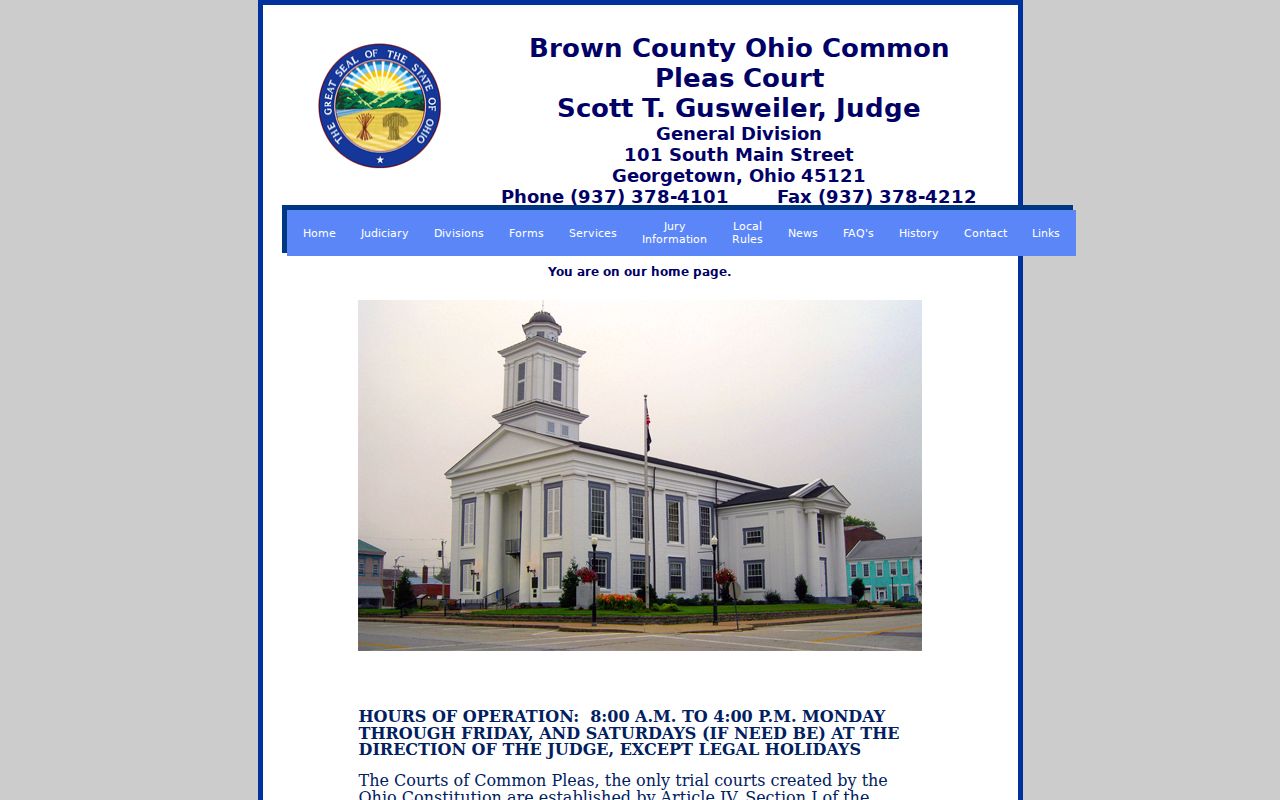
That division split is why a Brown County docket search begins with jurisdiction. No single portal works as a complete county index.
Court Dockets: What They Show
A Brown County docket is a chronological record of court activity. It is not a list of names. Municipal Court rules describe serially ordered civil, trusteeship, and criminal dockets. Each records the case number and title, the filing date, the nature of the claim or charge, minutes of motions or pleadings, and minutes of court orders. The Municipal journal serves as the daily record of orders. Common Pleas weekly dockets are narrower. They work as forward-looking calendars, not full histories.
A Common Pleas criminal or civil weekly docket lists the date, time, case number, case caption, hearing type, and counsel of record. It does not show financial balances. It does not provide downloadable papers, linked matters, or a final disposition. When a particular docket entry matters, ask the Brown County clerk. Ask what is in the public file.
| Case number and caption | Identify the court matter. A CaseLook numeric search accepts numbers only even when category filters show CR or CV. |
|---|---|
| Filing date | Shows when a paper or case was received and docketed; it is also a CaseLook search route. |
| Docket minute | Records a motion, pleading, order, or other action, with the Municipal Court journal serving as the daily order record. |
| Hearing setting | Shows the scheduled event. A weekly list may include time, type of hearing, and counsel but may change. |
| Disposition | Means final resolution of a charge or claim. An advance calendar entry does not prove one. |
Brown County Docket Codes in Plain Terms
Brown County CaseLook sorts a search with short labels. Common Pleas uses CA for Appeals, CV for Civil, CR for Criminal, DR for Domestic Relations, JL for Judgment Lien, and MI for Miscellaneous. Municipal Court uses TR for Traffic, CR for Criminal, and CV for Civil. SM covers Small Claims. PR covers Parking. Treat these as filters, not a verified universal case-number pattern.
- Docket
- The court's chronological record of filed papers, orders, settings, and case activity.
- Arraignment
- A criminal or traffic hearing where a charge is addressed and a plea may be entered.
- Pre-trial
- A conference before trial. Brown Municipal traffic rules use a pre-trial after a not-guilty traffic arraignment.
- Continuance
- A court-approved postponement of a scheduled event.
- Journal entry
- The court's formal written entry or daily order record.
CaseLook's numeric instruction matters: search 123456. Do not guess a letter-and-number combination. A ticket-payment screen may use a TRD-style reference for payment handling, but that example does not replace the Brown County CaseLook rule.
Brown County Courts and Their Dockets
Several offices hold Brown County court records. The Court of Common Pleas houses General and Domestic Relations divisions at the historic Georgetown courthouse, while Probate and Juvenile share a separate combined court office. Brown County Municipal Court runs its own clerk counter and CaseLook portal. A village citation may first name a mayor's court. Each route answers a different docket question. The Ohio trial-court directory shows where Brown County fits in the state court structure. State appellate dockets are separate again. The Supreme Court of Ohio online docket covers Supreme Court matters, not Brown County trial-court cases.
| Court or division | Docket covers | Where to search or confirm |
|---|---|---|
| Common Pleas, General Division | Adult felonies, civil cases regardless of amount, and some administrative appeals. | Common Pleas CaseLook, civil or criminal weekly docket, and Clerk of Courts counter. |
| Common Pleas, Domestic Relations | Divorce, dissolution, custody, visitation, and support matters. | Common Pleas CaseLook with DR, domestic weekly docket, and first-floor clerk. |
| Brown County Municipal Court | Limited civil, small claims, traffic, parking, and criminal matters. | Municipal CaseLook, Calendar Search, clerk counter, or eligible ticket-payment route. |
| Probate and Juvenile Court | Probate, estates, guardianships, adoptions, and juvenile matters. | The separate court's weekly-docket links and East State Street clerk office. |
Brown County Mayor's Courts Need Separate Contact
Brown County runs nine village mayor's courts: Aberdeen, Fayetteville, Georgetown, Hamersville, Higginsport, Mount Orab, Ripley, Russellville, and Sardinia. Each one keeps its own door. The Ohio Supreme Court Mayor's Court directory lists the phone numbers and addresses. Use it to reach the right clerk. What it does not offer is a case lookup. These nine courts post no online docket search. A call is the only way to check a court date or case number.
That matters most for a village ordinance, parking, or traffic ticket. A citation from one of these courts may never show up in Municipal CaseLook at all. If the case transfers, Brown Municipal Rule 5.01 requires a transfer entry plus the original pleadings. Only then will Municipal Court set an arraignment. So call the court named on your paperwork, not a neighboring one.
For county-level office context beyond these separate local courts, the Brown County government homepage is the place to look.
Brown County's village structure explains why a traffic search can start outside the countywide Municipal Court portal.
Note: Brown County has no incorporated Ohio cities, so a city-page docket route would misstate the legal classification of its incorporated places.
Court Dates and Settings in Brown County
Start a Brown County court date search with the right CaseLook Calendar Search form. Enter a beginning date. The ending date is up to you. Expect a CAPTCHA before results load. The Common Pleas filters cover appeals, civil, criminal, domestic relations, judgment liens, and miscellaneous cases. Municipal Court filters cover traffic, criminal, civil, small claims, and parking. Neither form offers a way to narrow by judge, courtroom, or setting type.
Common Pleas adds three weekly calendar routes open to the public: civil, criminal, and domestic relations. The criminal and civil lists give you the date, time, case number, and caption. They add the hearing type and counsel. Remember what a setting is. It marks the next scheduled event, nothing more. A setting posted in advance does not prove a trial date. It does not prove any result. Continuances, settlements, pleas, or other changes can still move it.
The Brown County court schedule lists every calendar channel plus the confirmation numbers. Here is the practical chain: try Calendar Search or the weekly docket first. Then call the assignment office or clerk. If online access fails, the in-person counter is the last stop.
Brown County Weekly Calendars and Paper Lists
Paper still works when a portal does not. The Common Pleas court says Assignment Officers print a weekly docket for proceedings. They post it outside courtroom doors. They also leave listings at the front security desk. Visitors pass through a front-entrance metal detector. A paper calendar helps you spot a setting. But for a hearing that is close, confirm with the responsible office.
Municipal Court runs its own calendar route through CaseLook. That court hears traffic, parking, small claims, lower-level criminal, and limited civil matters. Its public homepage lists separate service links plus clerk contact. Check a Municipal Court date there. Do not assume a Common Pleas schedule answers for it.
The Brown County Municipal Court homepage shows that separate court route. It comes straight from the official source.
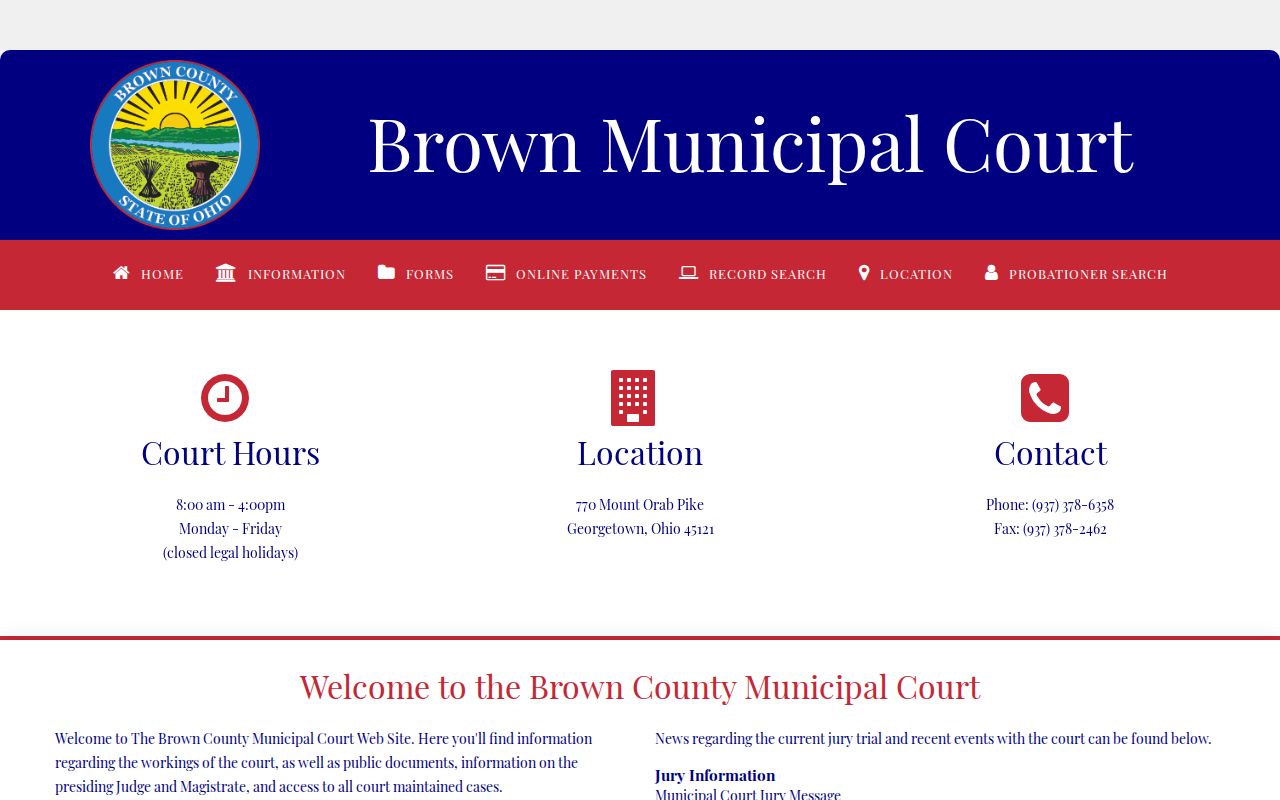
A separate Municipal Court location and portal drive the point home. In Brown County, calendar access depends on which court owns the case.
Docket Access Under Ohio Law
Ohio treats court-record access court by court. The Ohio Public Records Act, R.C. 149.43 backs inspection and copies of public records held by public offices. Court files answer to the current Ohio Rules of Superintendence 11.09 through 11.17 as well. Those rules cover court-record access, redaction, restrictions, and remote availability. Brown County Common Pleas Local Rule 34 keeps older numbering. So read the statewide rules alongside local procedure.
Key Rules:
R.C. 149.43 supports public-record inspection and copies, subject to court-record rules and lawful exceptions.
Sup.R. 11.09-11.17 set the statewide framework for direct access, remote access, redaction, and restricted court records.
R.C. 2953.33 addresses certain sealing and expungement situations; eligibility depends on the statute and case history.
Public access does not put every identifier or document image online. A missing image may reflect a portal limit, a posting delay, redaction, or a lawful restriction. The sound Brown County move: ask the custodian court for the public version available in that case.
Brown County Court Access Is Hybrid
Brown County's system is a hybrid. Online locators find things; counters confirm them. Common Pleas Local Rule 34 allows public review at the clerk counter under deputy-clerk supervision, one file at a time. The file stays in the office. Municipal Rule 1.05 likewise permits supervised in-person inspection. It also directs the deputy clerk to make requested copies. Neither rule promises remote access to every underlying record.
CaseLook earns its keep for finding a case, a court, or a likely date. An official copy or a current answer may still take a call. It may take a counter visit or a focused record request. The Common Pleas public-records form follows a practical local pattern: case number, requested entry, date, and requester name. A precise request for one judgment entry or docket range gives the clerk far more to work with. A broad request for a whole case does less.
Probate and Juvenile matters in Brown County go through the combined court office. Do not assume CaseLook searches them. Juvenile access can be tighter. Domestic Relations searches work with DR. Personal identifiers and restriction orders can shrink the public record, though.
How the Clerk Keeps Docket Records
The Brown County Clerk of Courts keeps Common Pleas General and Domestic Relations files. It also runs the locally hosted CaseLook routes for Common Pleas and Municipal Court. At the courthouse, civil and domestic filings go to the first-floor clerk office. Criminal and appellate filings go upstairs to the second floor. The Clerk of Courts does not hold every Brown County court record, though. Probate and Juvenile keep their own schedules, forms, fees, and clerk counter.
Copy prices come from the Common Pleas Clerk FAQ. Plain copies cost 10 cents per page. A certified copy bearing the clerk's official seal is $1. The FAQ does not say how a multi-page certified request is totaled. So confirm the current amount before ordering. These copy charges are separate from filing deposits, which are not docket-search or record-copy prices.
Brown County Clerk of Courts
101 South Main Street
Georgetown, OH 45121
(937) 378-3100
Brown County Court Statistics Explain the Split
The filing numbers explain the split. The Ohio Supreme Court's 2025 eStats reports list 6,611 new Municipal Court filings against 719 new Common Pleas General Division filings. Domestic Relations reported 281 new filings. Juvenile reported 585. These are court-operation totals only. They say nothing about an individual case or a coming hearing date.
The Ohio court statistics dashboard provides the official reporting context.
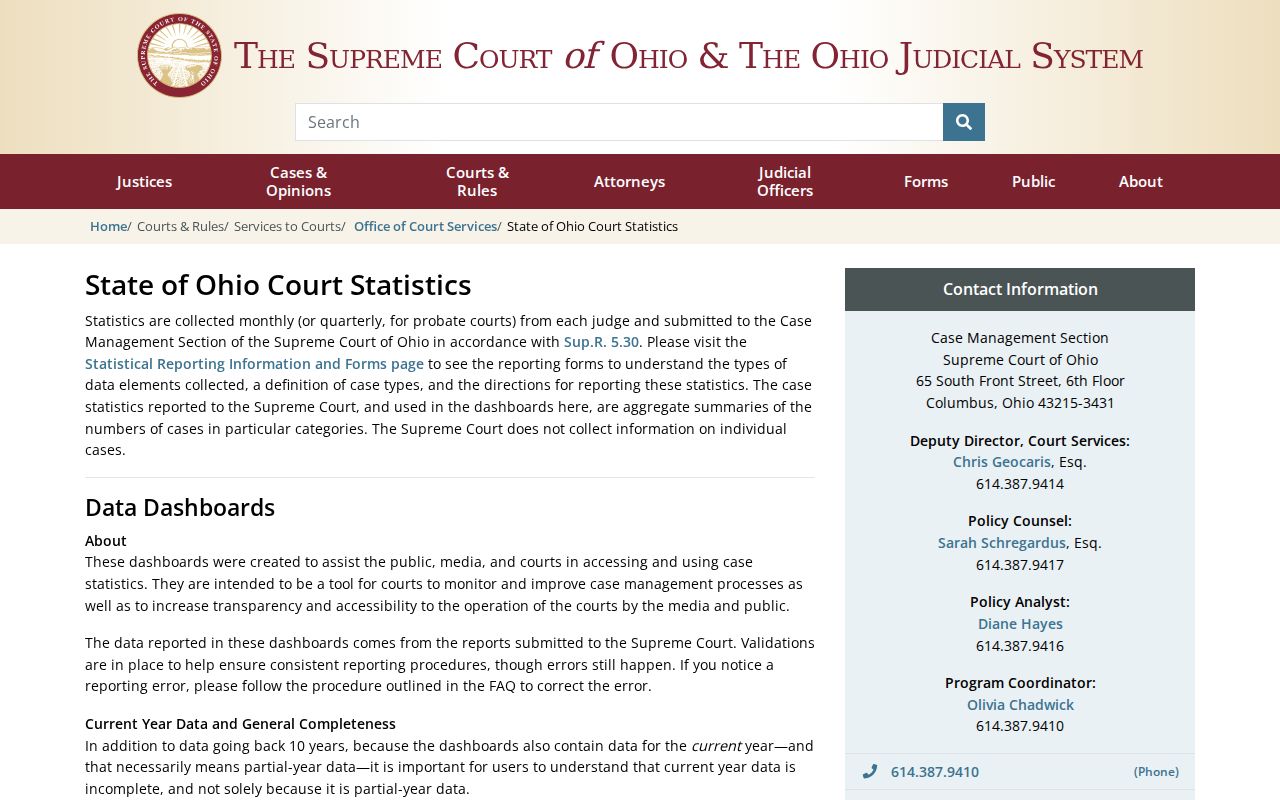
Municipal Court volume dwarfs the rest. That scale backs the practical rule: traffic, small claims, and many lower-level criminal searches need their own Brown County portal.
Brown County Docket Files and Transcripts
A docket entry tells you only that something happened. It may point to a pleading, a return of service, an exhibit, or a judgment entry. Those sit in the full case file at the clerk's office. Common Pleas Local Rule 38 keeps original court papers in the clerk's custody. When you call, name the document you want. Cite the dated judgment entry or a specific docket range. That request gets you further than asking vaguely for a docket.
Transcripts and recordings follow a different path in Brown County. The Common Pleas court reporter needs the case caption, case number, hearing date, hearing type, and judge before work can begin. Published rates differ for an original regular transcript, paper copies, electronic copies, and CDs. Proceedings older than December 2017 may exist only as audio. Also note that court-reporter charges sit apart from ordinary clerk-copy fees.
Once you have located the case, the Brown County court case records route explains copies, certification, restrictions, and the proper custodian in more detail.
City-by-City Court Dockets in Brown County
Brown County has no incorporated Ohio cities. Its municipalities are villages. The five largest by 2020 Census population are Georgetown, Mount Orab, Ripley, Aberdeen, and Sardinia. Each village runs a mayor's court, though none of them posts an online public docket. A set of city-docket pages would mislabel the local governments. It would also point readers toward a search route that does not exist.
For a village citation, look first at the court printed on the ticket. The official mayor's-court directory lists current contact information for each village. If a matter gets transferred, the Brown County Municipal Court is the next place to check. The countywide record map serves readers better here. A made-up group of locality pages never could.
Map and Directions to the Brown County Courthouse
Common Pleas General Division and Domestic Relations files are kept at the Brown County Courthouse, 101 South Main Street in Georgetown. Civil and domestic filings go to the first-floor clerk office off the Main Street entrance, while criminal and appellate filings go to the second-floor office. The stone, Greek Revival building was designed by Hubbard Baker and completed in 1851, with a bell-tower clock, a 1914 addition, and a rebuild after 1977 fire damage.
Brown County Clerk of Courts
101 South Main Street
Georgetown, OH 45121
(937) 378-3100
Monday through Friday, 8:00 a.m. to 4:00 p.m., with Thursday service to 6:00 p.m.
Visitors pass through front-entrance metal detectors, and the court says cell phones, other recording devices, knives, scissors, box cutters, weapons, and aerosol cans cannot enter. Free street parking surrounds the courthouse, but there is no single court lot, and spaces immediately behind the building are reserved for probation and police vehicles. The building is wheelchair accessible, with an elevator serving the criminal-courtroom floor.